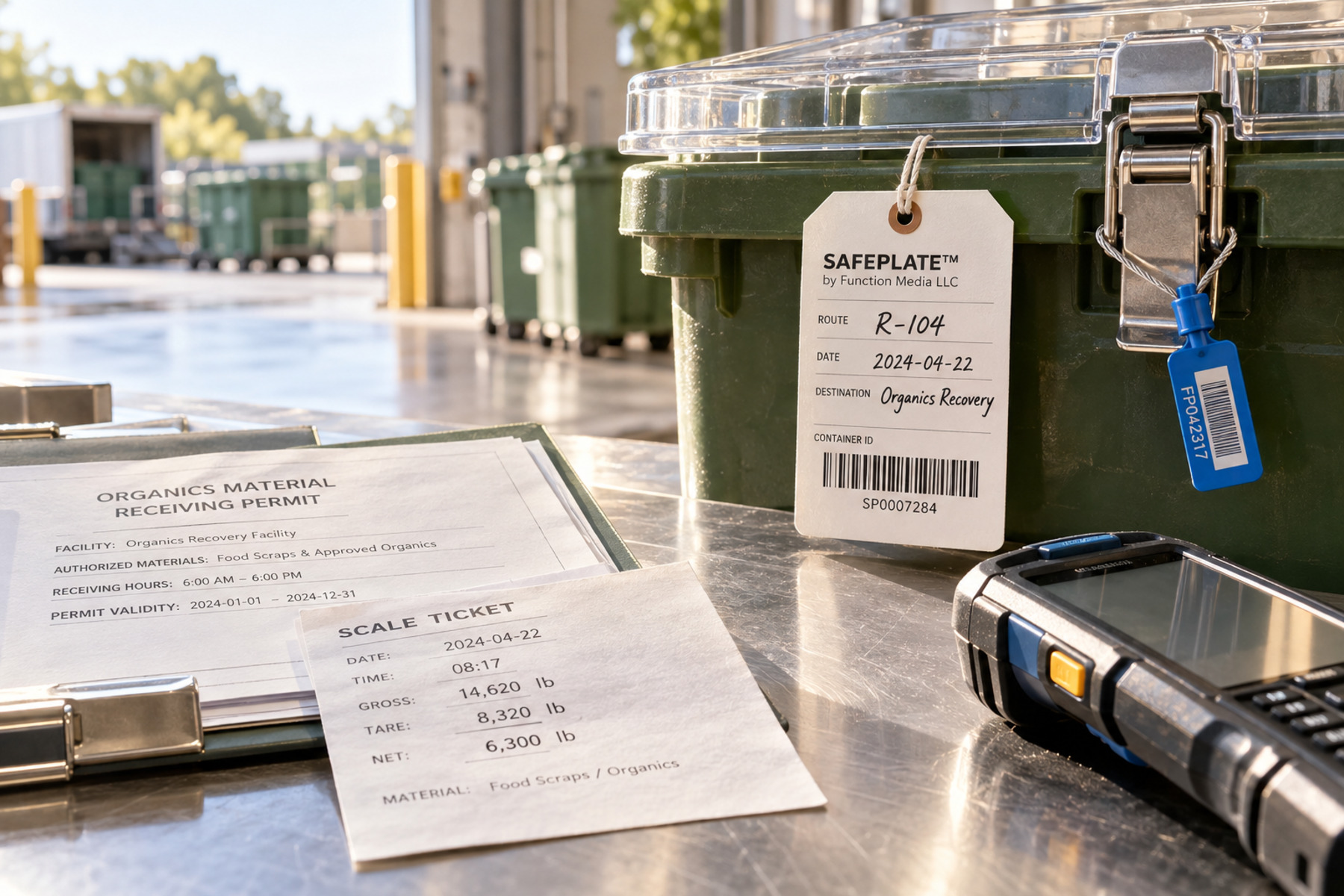
Food recovery is often described as a routing problem: find a nearby pantry, processor, composting site or anaerobic digester and send material there. That framing is convenient—and incomplete.
A destination may exist but be closed. It may accept pre-consumer vegetable scraps but reject packaged food, meat, liquids or compostable serviceware. Its authorization may have expired. It may be listed under an outdated name. A transporter may leave with the material while the institution never receives proof of delivery.
The result is a dangerous gap between intention and evidence. A route can look sustainable in a directory while remaining operationally unverified.
SAFEPLATE™ by Function Media LLC is being developed around a stricter premise: the safest and most beneficial disposition depends on the condition of the food, its intended use, local rules, current facility capability and a documented handoff. Composting is valuable, but it is not automatically the right answer. Donation, upcycling, animal feed, anaerobic digestion, composting and disposal each require different evidence.
A destination record is a claim, not a conclusion.
Public and commercial directories are useful starting points. They help reveal possible capacity. But a name, address and category do not establish that a facility is eligible for a particular material on a particular day.
EPA’s Wasted Food Scale distinguishes pathways because they produce different benefits and impacts. Prevention, donation and upcycling are generally preferred to pathways that manage food after it becomes waste. EPA also cautions that the scale addresses environmental impacts and does not by itself resolve every economic, social, safety or local regulatory question.
That means routing cannot be reduced to “nearest compost site.” The first question is whether edible food can safely remain in the human food system. The next is which lawful, operationally available pathway fits the specific material. Only then should distance and logistics decide among verified candidates.
A pin proves location. Verification requires identity, authority, material fit, handoff evidence and a current receipt.
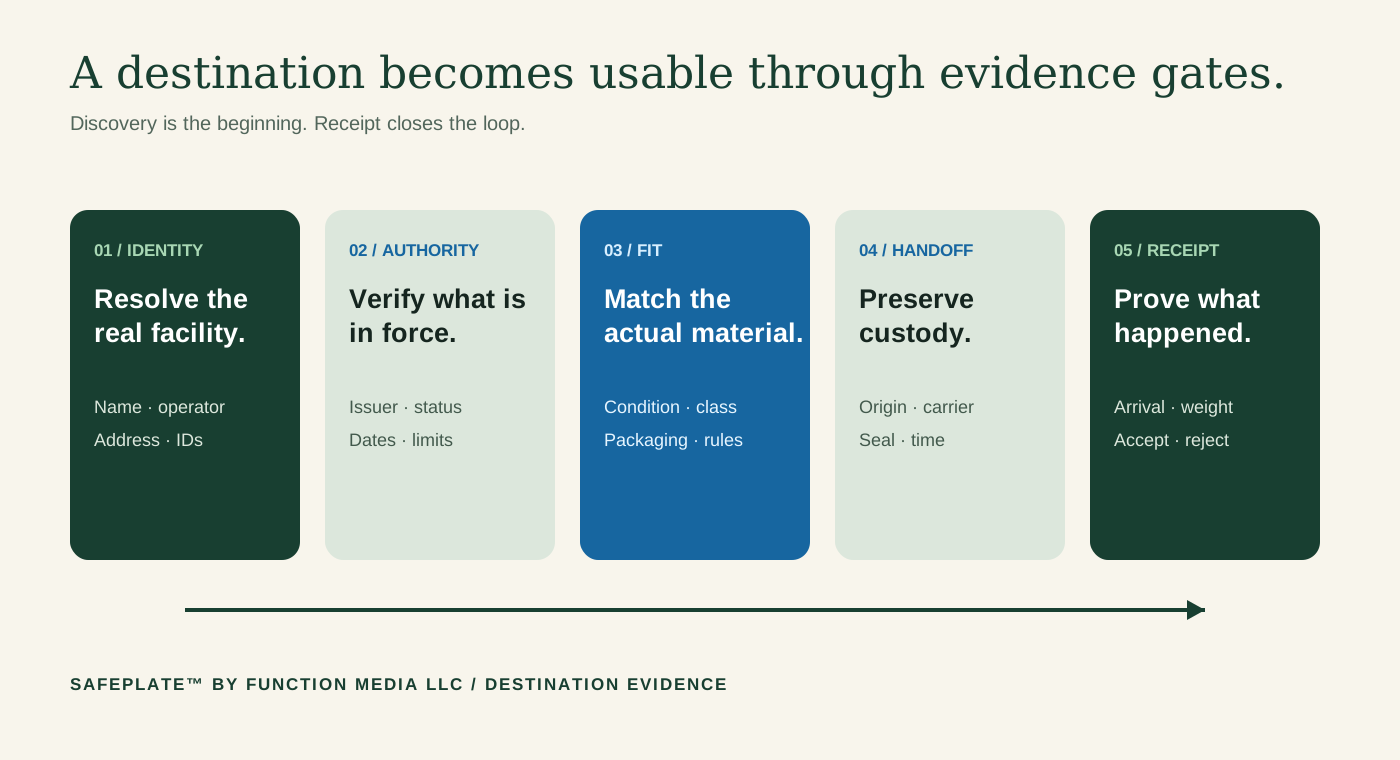
Five evidence gates turn a listing into a usable destination.
Resolve the real facility.
Match the legal or operating name, physical location, operator and stable identifiers. Record former names and duplicates instead of assuming similarly named listings describe the same place.
Verify the permission in force.
Identify the applicable permit, registration, approval or other governing record, its issuer, status, effective dates and any operating conditions. A record without a current source and verification date should remain unverified.
Match the material to current acceptance rules.
Distinguish edible from inedible material; packaged from unpackaged; liquids from solids; pre-consumer from post-consumer; and ordinary organics from recalled, contaminated or otherwise restricted material. “Accepts food waste” is too broad to support a defensible route.
Preserve custody across the route.
Record the origin, transporter, seal or load identifier, planned destination, departure time and any temperature or handling conditions that matter. Exceptions and substitutions should be explicit rather than silently overwriting the plan.
Close the loop with destination evidence.
Retain a receiving timestamp, destination acknowledgement, weight or quantity, accepted or rejected material classification and any discrepancy. The record should show what actually happened, not only what was scheduled.
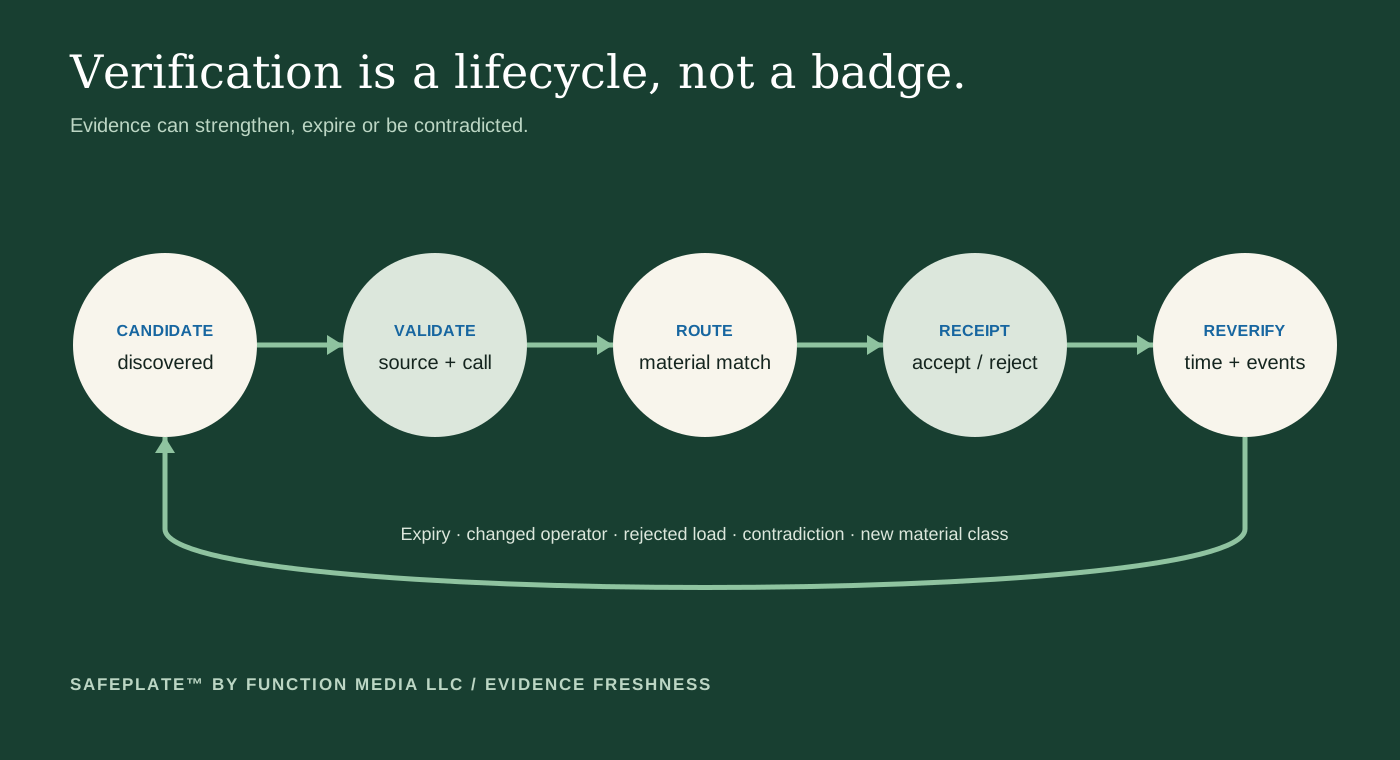
“Verified” needs an expiration date.
Facility evidence changes. Permits are renewed, suspended or replaced. Operating hours shift. Accepted-material lists change with contracts, equipment, contamination rates and markets. A site that was a valid destination six months ago may not be valid for today’s load.
Every verification should therefore carry a source, method, verifier and timestamp. The system should distinguish official-record confirmation, direct facility confirmation, observed receipt evidence and third-party directory information. Those evidence classes are not interchangeable.
A useful record also defines when re-verification is required. Time can trigger review, but so can a returned load, changed operator, new material type, expired authorization, contradictory source or failed delivery. “Verified once” must never become “verified forever.”
Donation and organics processing require different safety questions.
Edible-food donation keeps food serving its intended purpose, but it depends on safe handling, storage, transport and recipient capability. FDA’s retail-food guidance emphasizes hygiene and food-safety practices for donated food. A responsible system should not recommend donation merely because a recipient is nearby; it should represent whether the food is eligible and whether the intended recipient can accept it safely.
Inedible material may be suitable for composting or anaerobic digestion, but those pathways have different processes, equipment and acceptance limits. EPA describes composting as an aerobic process and anaerobic digestion as a process without oxygen that produces biogas and digestate. The operational distinction matters: a destination designed for one pathway should not be inferred to support the other.
Source separation matters too. EPA contracting guidance notes that collection agreements can specify which recyclable and compostable materials are collected and how. Contamination prevention begins before the truck arrives, with clear material rules at the point of generation.
A rejection is operational evidence.
A rejected load is not merely a failed transaction. It can reveal that a material profile was wrong, a directory record was stale, a facility changed its policy, the carrier reached the wrong location or the route lacked required documentation.
The system should capture the reason, quantity, timestamp and next disposition without converting the failed route into a successful one after the fact. Rejection patterns can then improve future matching while preserving the original evidence trail.
This is especially important when food condition or contamination risk changes during transport. A delayed or temperature-abused load may no longer be eligible for the pathway originally selected. The safe next step must be based on current condition and applicable requirements—not on the inconvenience of changing the plan.
National coverage must not pretend national verification.
A national map can be assembled from public records, program directories and facility datasets. That creates discovery coverage. It does not create universal verification.
SAFEPLATE should state the stage of every record: candidate, source-identified, independently checked, destination-confirmed, receipt-proven, expired or contradicted. Unknown must remain visible. That stage control is more useful than a larger map filled with unsupported green checkmarks.
The practical goal is not to make every facility look certain. It is to make the evidence state clear enough that institutions can route responsibly, know when human confirmation is still required and preserve proof of what occurred.
SAFEPLATE™ is under development by Function Media LLC. This article describes research and product direction; it does not claim national deployment, facility approval, certification or independently validated destination coverage. Function Media LLC is led by Illya Knight, Founder & Managing Member, with Shea Johnson as co-owner.