
VERISCOPE™ by Function Media LLC | Optical Index Edition
An analyst enters a name, an event and a date. In less than a second, the system returns twelve results. One appears first. Another carries the most confident summary. A third uses the exact phrase the analyst searched.
None of those qualities makes a result authoritative.
Search is an act of retrieval. Evidence is an act of preservation, comparison and review. The two can work together, but they are not interchangeable.
That distinction matters in institutional systems because ranking creates its own kind of persuasion. The first result feels important. A clean excerpt feels complete. A high similarity score feels reliable. Yet the source may be outdated, derivative, outside the relevant jurisdiction or contradicted by a record that ranked lower.
The search result is a route to evidence. It is not the evidence itself.
Retrieval answers a different question
A retrieval system asks: which records appear most relevant to this query?
An institutional reviewer must ask more:
- Who created the record?
- Was that person or organization authoritative for the question?
- When was it issued, observed and retrieved?
- Is it original, quoted, summarized or copied?
- Which entity does it actually describe?
- Has it been corrected, superseded or challenged?
- What evidence disagrees with it?
- What action is the reviewer permitted to take?
Relevance helps locate material. It cannot answer those questions by itself.
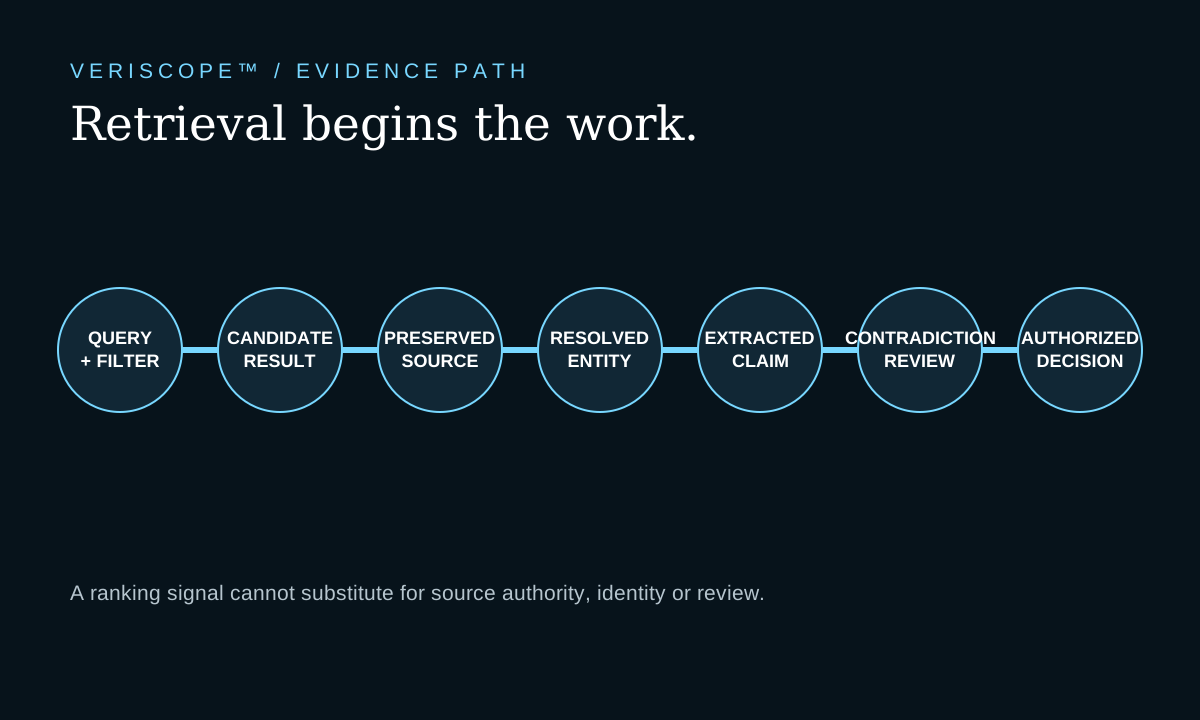
This is why VERISCOPE™ is being designed around an evidence pipeline rather than a search box alone. Retrieval is one stage. Source preservation, normalization, entity resolution, chronology, contradiction detection and human review are separate stages with separate failure modes.
A snippet is a projection
Search excerpts are useful because they compress a document into a few visible lines. That compression also creates risk.
A sentence can appear decisive when the paragraph immediately below it adds a condition. A date can refer to publication rather than the event. A name can belong to a different person or organization. A quoted statement can be presented without the source that originally made it.
The snippet is therefore a projection produced for a particular query. Change the query and the excerpt may change even though the underlying document does not.
A responsible evidence system should preserve the exact source snapshot used in review, the location of the excerpt inside that source and the retrieval conditions that surfaced it. The reviewer should be able to move from summary to passage to complete record without losing context.
Rank is not authority
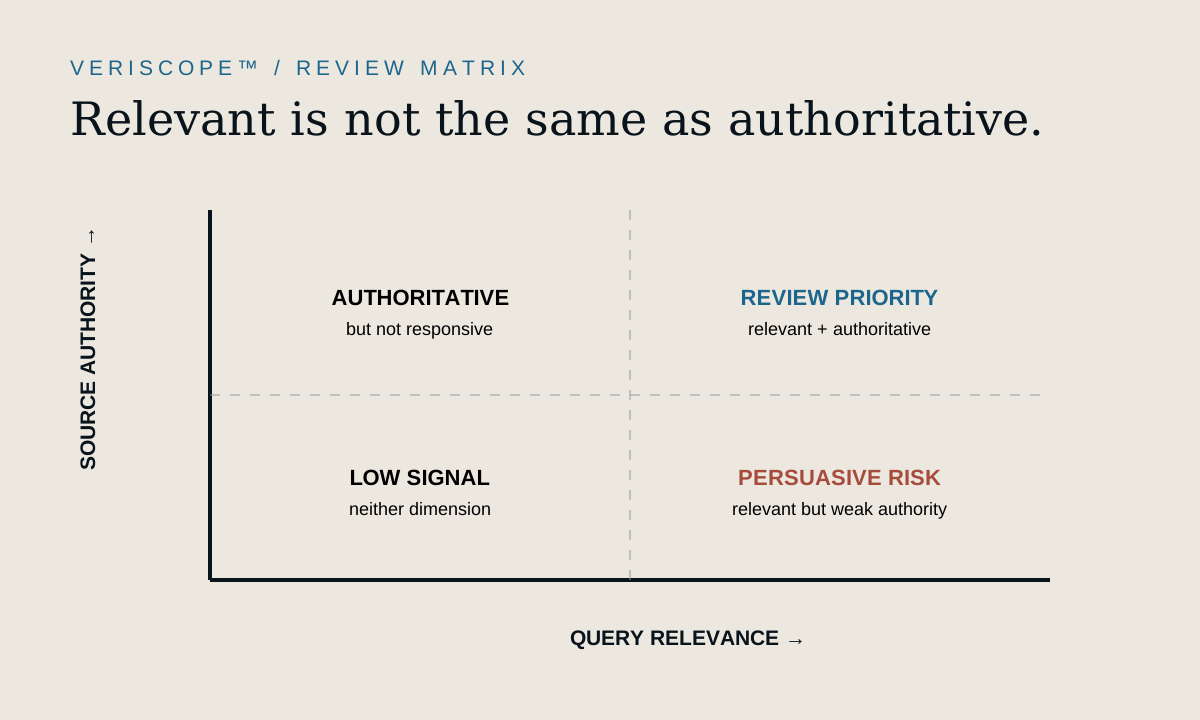
Ranking systems optimize for useful ordering. Authority depends on institutional context.
For one question, a federal rule may control. For another, a state directive, contract term, board policy, laboratory result or signed case record may be decisive. A widely repeated news story can rank above the quiet primary document that actually establishes the fact.
Authority also changes by time. A policy that controlled last year may have been replaced. A preliminary notice may later become a final decision. A source can remain authentic as a historical record while no longer governing current action.
VERISCOPE’s design direction separates relevance, authority, freshness and evidentiary completeness. Those dimensions can inform one another, but they should not be collapsed into a single confidence number.
The original source may not be the nearest source
Information travels.
An agency releases a notice. A trade publication summarizes it. A vendor republishes the summary. A social post quotes the vendor. A model produces a synthesis of the social post and three other pages.
By the time an analyst finds the claim, the language may be several steps away from the originating record.
The closest available page is not necessarily the closest evidentiary source.
Source lineage should make those transformations visible. A derived item can still be valuable: it may add context, explain impact or reveal how information spread. But the system should distinguish the origin, the derivative publication and the analyst’s interpretation.
This distinction protects both accuracy and intellectual honesty. It prevents a polished synthesis from silently replacing the record it summarized.
Entity resolution comes before conclusion
Search systems are good at finding strings. Institutional work depends on resolving entities.
Two people can share a name. One company can use several legal and public names. An address can represent a headquarters, processing facility, mailing location or former site. A school can belong to a district with a similar name in another state.
Matching text does not establish identity.
VERISCOPE’s engineering approach is to retain candidate matches, test them against available identifiers and preserve unresolved ambiguity. If two records might describe the same entity but the decisive identifier is missing, the system should say so. It should not merge them merely because doing so produces a cleaner graph.
That restraint is part of the technology. An unresolved state is often more truthful than an elegant but unsupported connection.
Contradiction should survive retrieval
Traditional search encourages a winner: one result rises above the others.
Evidence review sometimes needs the opposite. A reviewer may need to see the strongest record supporting a claim beside the strongest record contradicting it. The contradiction may reveal a correction, a jurisdictional difference, an identity error or a genuine dispute.
A system that ranks one source highly and hides the rest can create false certainty. A system built for institutional review should preserve meaningful disagreement and show why the records conflict.
The goal is not to make every decision appear uncertain. It is to make certainty proportional to the evidence.
Retrieval needs an observation time
A result set is not permanent.
Documents are added, removed and updated. Indexes change. Access fails. Ranking logic evolves. A later search may return different material for the same query.
For consequential work, the system should record when retrieval occurred, which sources were searched, which query and filters were applied and which version of the retrieval configuration was active. That does not turn a search into proof. It makes the search reproducible enough to audit.
NIST defines provenance around the origin and history of data and processes. The NIST AI Risk Management Framework emphasizes documentation, traceability and measured system behavior. GAO’s AI Accountability Framework likewise connects data quality, monitoring and governance. Applied to retrieval, the lesson is direct: a result should arrive with a history, not just a rank.
The interface should reveal the evidence boundary
A good institutional interface does not need to overwhelm the reviewer with technical metadata. It must make the boundary clear.
At minimum, a finding should distinguish:
- the retrieved candidate;
- the preserved source;
- the resolved entity;
- the extracted claim;
- corroborating and contradictory records;
- the system’s uncertainty; and
- the authorized human decision.
These are different objects. Presenting them as one block of generated prose makes review faster only by hiding where judgment is required.
VERISCOPE is not being positioned as an oracle. It is an evidence-centered infrastructure direction: retrieve broadly, preserve precisely, resolve carefully, surface disagreement and keep institutional authority with authorized people.
The result begins the work
Search has trained people to expect an answer at the top of the page. Consequential institutions need a more disciplined habit.
The first result is a lead. The snippet is a view. The similarity score is a retrieval signal. The source, its lineage and its relationship to other evidence determine what the institution can responsibly conclude.
The system becomes trustworthy not when it always produces an answer, but when it makes the path from query to source to decision visible.
Function Media LLC is developing evidence-centered systems that connect source lineage, operational context and human review. VERISCOPE™, SAFEPLATE™ and NORTHLINE™ demonstrate this broader applied-systems direction. No customer deployment, guaranteed outcome or measured performance is claimed here.
Working with Function Media: Selected paid institutional pilots, purpose-built systems, sponsored development, licensing, integration and strategic partnerships are considered through Function Media partnerships.