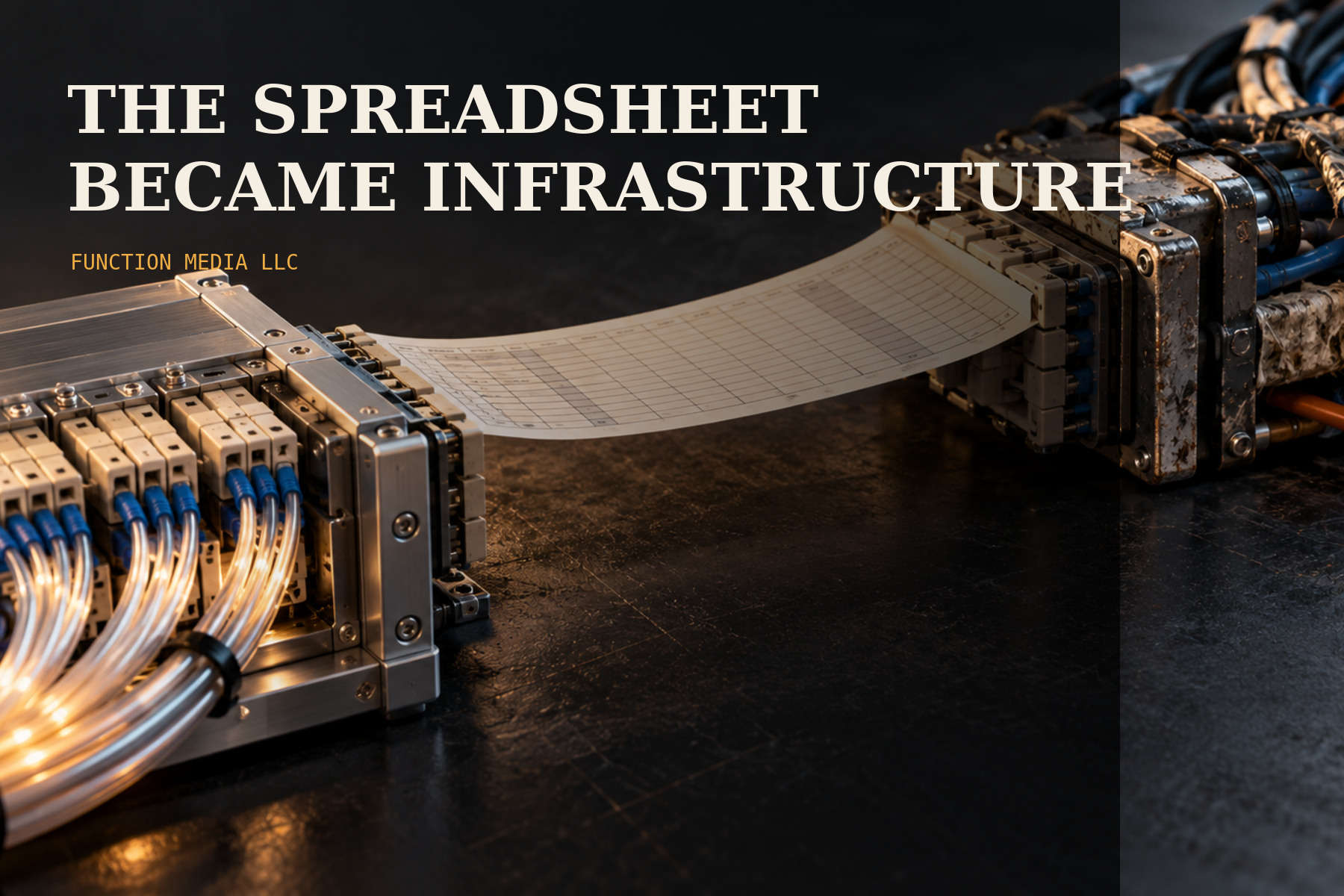
Most institutions do not set out to make a spreadsheet mission-critical. It happens because someone needs to reconcile records that were never designed to meet.
The official case system contains one view. Email contains another. A contract defines conditions the operational database does not represent. A field note supplies context that has not yet become structured data. A person builds a sheet to join them long enough to answer a practical question.
If the answer is useful, the file persists. It gains columns, colors, formulas, tabs, owners and rituals. Soon people cannot complete the work without it—even though the institution may have no formal account of what it does.
Four signs the file is infrastructure.
Work stops when it is unavailable.
If a team cannot perform a required handoff, report, review or reconciliation without the file, it is no longer incidental office material. Availability has become an operational requirement.
It carries meaning between systems.
Columns often translate identifiers, categories and status labels that do not align elsewhere. The sheet is not merely storing data; it is performing semantic integration.
People treat its state as actionable.
When a row determines who calls, approves, escalates or closes, the file participates in institutional authority even if no policy names it.
It preserves exceptions the systems forget.
Notes, overrides and manually reconciled histories may be the only explanation for why the official record looks the way it does.
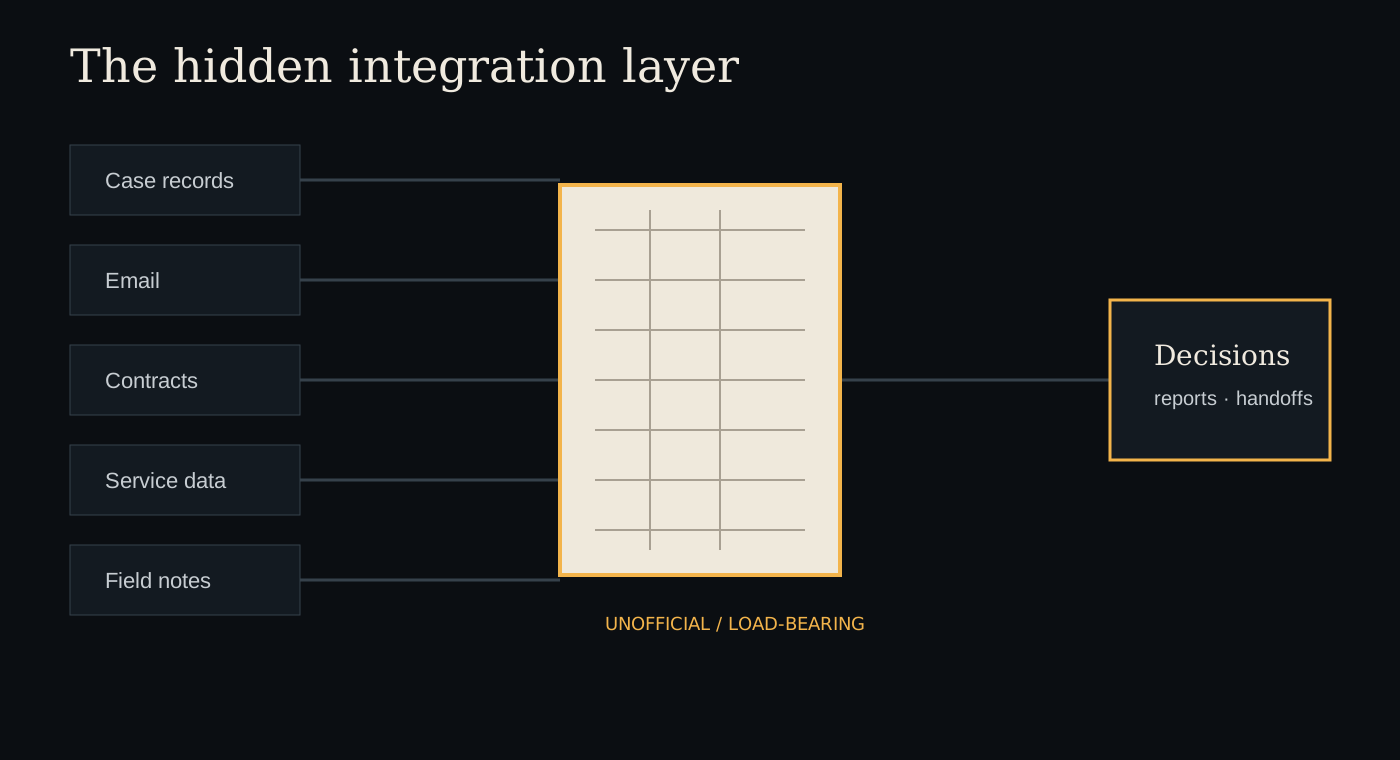
Calling it unofficial does not make its consequences unofficial.
The operating question is whether the institution knows what the file connects, who relies on it and what happens when it changes.
The risk is not the spreadsheet.
Spreadsheets are flexible, legible and widely available. Those qualities make them excellent tools for discovery, prototyping and local coordination. The danger begins when a load-bearing process remains invisible.
Invisible infrastructure has no assured owner, access model, backup practice, version rule or retirement plan. A copied tab can become a competing source of truth. A changed formula can alter downstream work without review. Context can remain trapped in color, comments or a colleague’s memory. Security controls may not match the sensitivity of the information.
A blanket prohibition rarely solves this. People create local tools because the work has a real gap. Removing the tool without resolving the gap pushes the same integration labor into email, memory or another untracked file.
Recognize the work before replacing the tool.
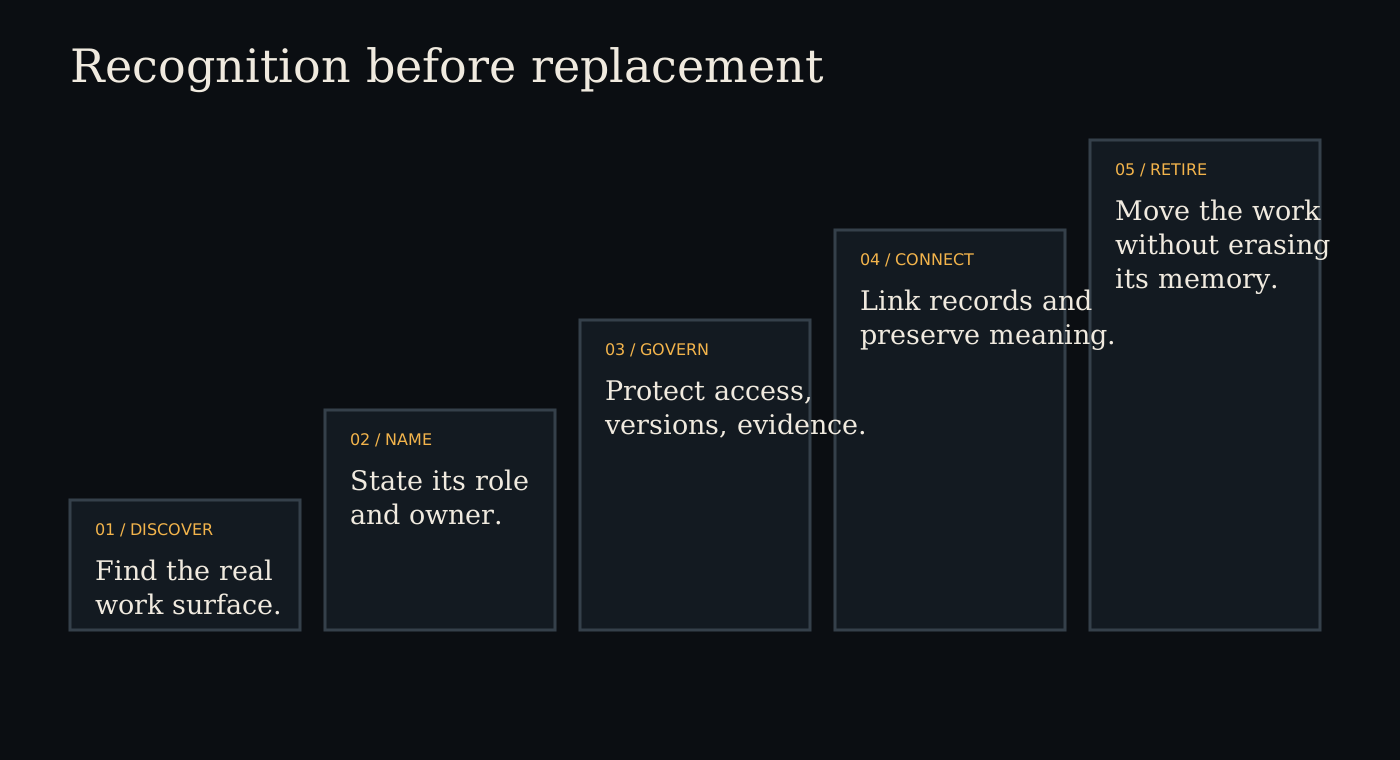
The first step is discovery: identify the files that real processes depend on. The second is to name their operating role, inputs, outputs, owners and users. Governance can then be proportionate to consequence—access control, versioning, retention, validation and review where each matters.
Only after that map exists should the institution connect or replace the file. Migration must preserve the meaning encoded in formulas, manual exceptions and local categories. A technically successful import can still destroy institutional memory if it moves values without their context.
A practical record for each load-bearing file.
A lightweight registry can capture the file’s purpose, accountable owner, data sources, downstream decisions, access conditions, update cadence, exception handling, current version, retention need and intended future state. The registry should not turn every worksheet into a major technology project. It should make consequence visible.
The review threshold should follow the work. A personal calculation has a different risk profile from a shared file that coordinates benefits, safety, inspections, contracts or public reporting. Governance becomes useful when it is specific enough to distinguish them.
What this reveals about institutional systems.
The spreadsheet is evidence of an unmet connection. It shows where formal records do not share identifiers, where policy is not represented in workflow, where exceptions matter more than averages, and where people are supplying the context machines lack.
Function Media LLC develops evidence-aware systems around those gaps. VERISCOPE™, SAFEPLATE™ and NORTHLINE™ represent distinct applied domains, while sharing a design commitment: preserve source, context, uncertainty and accountable human judgment when information crosses institutional boundaries.
This article presents a systems principle. It is not a claim of customer deployment, certification, guaranteed outcome or autonomous decision authority, and it does not disclose proprietary implementation methods.
The simplest test.
Ask which file cannot disappear on Monday morning. Then ask whether its role, owner, inputs, decisions, access and exceptions are documented anywhere outside the file itself. If the answer is no, the institution has already built infrastructure. It has simply not recognized it yet.